
Are you looking for a comprehensive guide to the cost structure, processes, and profit opportunities for sterile pharmaceutical powders? Here is a guide that provides direct answers to all important questions about the industrial setup process. Many pharmaceutical business owners consider investing in advanced solutions; thus, dry powder injection manufacturing is an important process in global healthcare delivery. The technology of dry powder injections produces highly stable, sterile antibiotic or critical care formulations that require an absolutely critical pharmaceutical setup. In this way, most essential medicines will be available only in powder form since liquids break down more quickly.
By getting rid of humidity during the high-speed vial filling process, dry powder injection manufacturers in India (also known across the industry as dry powder injection manufacturers India) provide very stable, high-quality medicinal supplies. Reputable dry powder injection manufacturers follow strict environmental controls at every stage of production.
At present, launching a compliant manufacturing facility requires a starting capital investment of ₹2 crores to ₹5 crores.
Nevertheless, third party dry powder injection manufacturing will allow corporate companies to minimize setup risks & earn an attractive injection profit margin of 25% to 40%.
What Is Dry Powder Injection Manufacturing and Why Is It So Important in the Pharmaceutical Industry?
Pharmaceutical business owners may want to know: Why is the technology of dry powder injections so important in today’s healthcare delivery? The technology of dry powder injection manufacturing produces highly stable, sterile antibiotic or critical care formulations that are extremely important for healthcare. There are many medicines that will be stable only when in dry powder form because they break down in liquids rather quickly. In this way, it becomes the foundation for preserving unstable therapeutic compounds.
- Enhanced Chemical Stability: Moisture-sensitive medicines like cephalosporins will remain chemically active in powder form.
- Accurate Sterile Dosages: All glass vials will be precisely filled with powdered medication using specialized equipment.
- Enhanced Product Shelf Life: The commercial expiration date will be extended to three full years due to the removal of moisture.
- Immediate Treatment: Doctors can immediately administer the dry powder with water as an infusion treatment.
- Minimized Preservation Needs: Dry medicine formulations will not require expensive chemicals for preservation.
- Flexible Corporate Solutions: Brands will get the needed amount of medicine faster with contract manufacturing.
- Cost-efficient Distribution: Light glass vials will reduce international shipping overhead for manufacturers.
Specialized healthcare markets depend greatly on dry powder injection manufacturers in India, who have advanced environmental controls for the elimination of humidity during high-speed vial filling. Buyers can review our complete dry powder injection product list to see the range of formulations available.
How is Sterile Dry Powder Injection Manufactured?: A Step-by-Step Guide
Here’s a simple dry powder injection manufacturing process flow chart that shows all five steps at a glance, from mixing the raw materials to the final quality check.
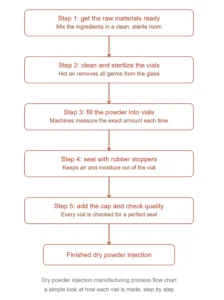
Step One: Raw Materials Formulation
At first, skilled workers will start by obtaining active pharmaceutical ingredients under sterile conditions in a special preparation room. Secondly, the mixture of active pharmaceutical ingredients will be uniformly combined. In this way, the first step starts the dry powder injection manufacturing process correctly.
Step Two: Sterile Vial Sterilization
In turn, automatic machines will wash and sterilize glass vials in the high-temperature depyrogenation tunnel before filling the contents. Consequently, dry injection manufacturers in India will eliminate all potentially dangerous pyrogens or microorganisms before the actual filling process. In this way, dry powder injections will be absolutely sterile.
Step Three: Precise Powder Filling
In addition, the high-speed automatic machines will dose precise quantities of sterile powder into the glass vials using vacuum pressure. Electronic sensors will be used to measure the weight of filling so that no mistakes in dosages occur. Thus, ensuring that there is a WHO GMP certified dry powder injection line is a must.
Step Four: Rapid Rubber Stoppering
Once the vials have been filled with the dry powder, sterile butyl rubber stoppers will be applied to each one by using automated machines. This process will help completely seal the powder against any environmental exposure to air and humidity.
Step Five: Aluminum Capping and Inspection
Finally, aluminum caps will be fitted on top of the glass vials. A visual system will scan all final products for minute sealing flaws or glass imperfections. Finally, dry injection contract manufacturing plants will produce perfectly sealed units for international markets.
Factors Influencing the Cost Structure of Dry Powder Injection Manufacturing in India
Setting up a dry powder injection manufacturing facility involves many different costs, such as the purchase of equipment and infrastructure investments. Below, you can see the estimated cost categories and purposes of expenses associated with the setup process in India.
| Type of Investment | Expected Cost Ranges (Rupees) | Purpose for Operation |
| HVAC systems for clean rooms | ₹45 Lacs to ₹80 Lacs | Maintaining a sterile Class 100 air environment |
| Automated filling line | ₹70 Lacs to ₹1.5 Crores | Powder filling at high speed |
| Sterilization tunnel | ₹30 Lacs to ₹60 Lacs | Killing microbes on glass vials using dry heat |
| Lab set-up | ₹25 Lacs to ₹50 Lacs | Testing strict HPLC and sterility tests |
| Licensing and certification | ₹5 Lacs to ₹12 Lacs | State drug approval license |
How Lucrative is the Business of Dry Powder Injection Manufacturing?
As we mentioned above, the average dry powder injection profit margin for well-managed businesses falls in the range of 25% to 40%. The automation of the filling process leads to reduced losses due to raw material waste during large-scale manufacturing. This way, manufacturers will recoup their investment relatively quickly while maintaining high product quality.
Increasing Demand from the Global Market
The global healthcare market needs a huge amount of sterile, low-cost antibiotic injections every single day. This requirement provides predictable sales numbers and revenue streams for manufacturing facilities every month. Therefore, the business will become highly profitable due to stable cash flows and minimal inventory depreciation.
Optimization of Operating Cost Structures
Manufacturing facilities maximize their machinery usage rates by organizing multiple shifts on a daily basis. Buying active ingredients and packaging in bulk quantities will significantly decrease the cost of goods sold. In this way, scaling the dry powder injection manufacturing process will help to improve profitability.
B2B Contracting Services
In addition, there are many brands in pharmaceutical manufacturing that prefer outsourcing their production. This corporate preference means that third party dry powder injection manufacturing businesses will be more popular. Hence, smaller manufacturers can obtain long-term manufacturing orders and produce reliably.
Growth Potentials for Export Ventures
Lastly, dry injection manufacturers in India will ship a huge volume of their products to other developing countries through international trade deals. Such transactions generate much higher profit margins than domestic markets. In this way, the company will benefit from significant financial growth.
Conclusion
Summarizing our analysis, we should say that dry powder injection manufacturing involves high-tech operations and advanced environmental controls. By cooperating with a professional dry powder injectables manufacturer such as Pushkar Pharma, business owners will gain access to premium dry injection contract production solutions. The organization provides top-level quality, full compliance, and good business returns on investment.
Make sure to check the list of India’s best injection manufacturers before choosing your liquid injection manufacturer.
FAQ
What is the primary purpose of dry powder injections?
Dry powder injections are used to inject sterile, moisture-sensitive medications into patients by reconstituting them with sterile water.
Why do many brands prefer outsourcing dry injection manufacturing?
Outsourcing enables companies to cut down on expensive factory setup costs by making full use of the knowledge of seasoned contractors.
What is the profit margin for dry powder injection?
A properly run manufacturing plant will make a yearly profit margin from 25% to 40% owing to its higher volume of sales.
What licenses are required for operating dry powder injection plants?
All facilities must obtain state drug manufacturing licenses along with standard WHO GMP certified dry powder injection certification documents. They will prove compliance with the rules.
What could be the reasons behind inconsistent powder filling?
This problem could be associated with powder moisture content inconsistencies and filling wheel speed adjustments. Routine calibration and humidification controls will resolve the issue.
How long does a facility validation process for dry powder manufacturing last?
Completing the facility validation will require three successful batches, which takes two to three weeks in total.
Why do manufacturing plants prefer glass containers over plastics for powder?
Type 1 borosilicate glass will provide high resistance to thermal shock and inertness with respect to medicine. Hence, sensitive substances will never interact with glass.
Why do manufacturing companies benefit from outsourcing dry powder injections?
Outsourcing enables marketing companies to launch new prescription products rapidly without costly infrastructural investments.