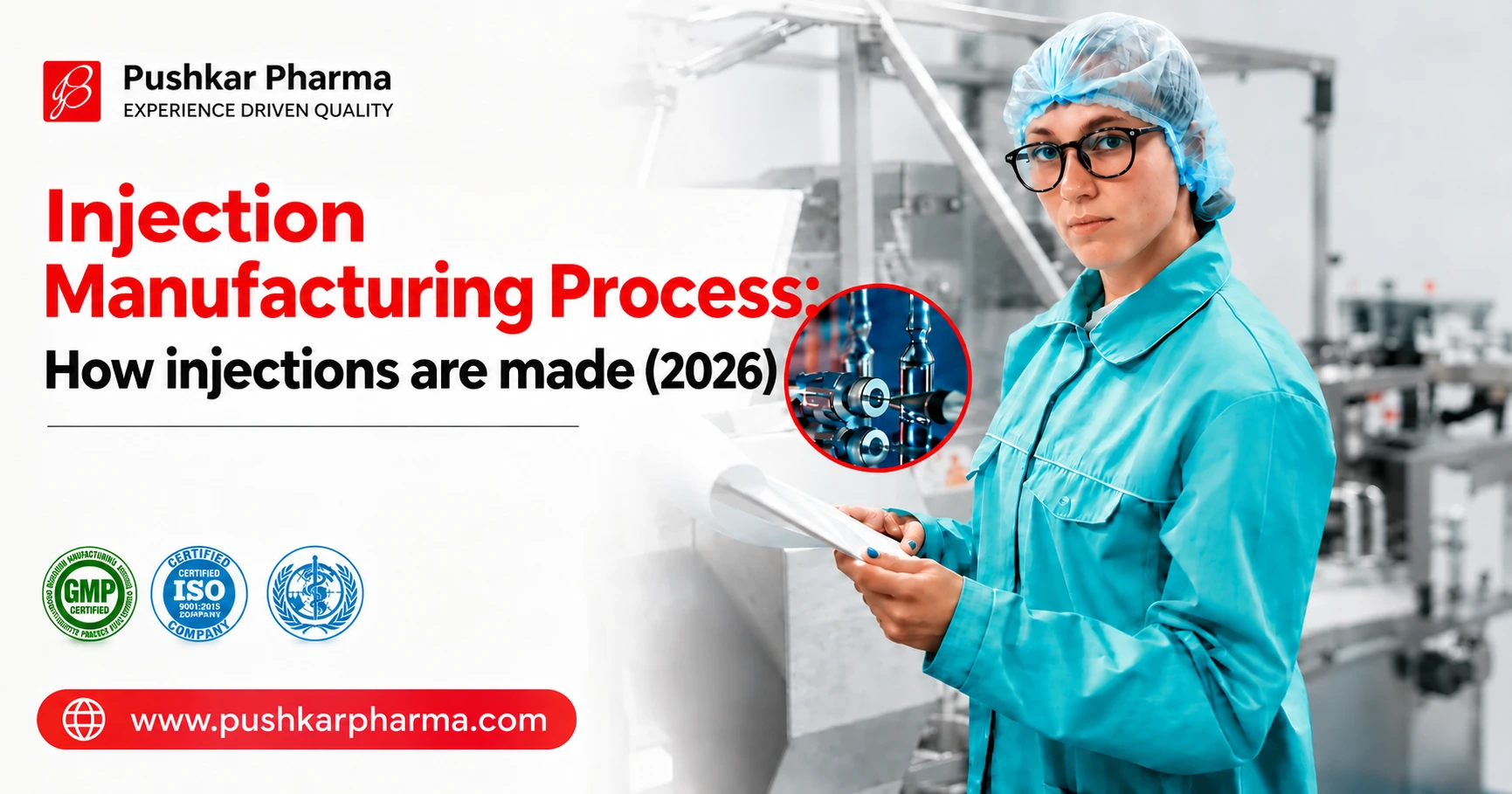
As no defense is provided by the body to injectable medicines, their production needs to be carried out under absolutely sterile conditions and with proper dosages. The sterile injection manufacturing process includes chemical formulation, microfiltration, aseptic filling & sealing in an ISO Class 5 clean room environment.
Understanding how injections are made allows pharmaceutical brands to ensure complete safety and quality control. For 2026, setting up a WHO-GMP-compliant manufacturing facility will require an initial investment amount of ₹1.5 crore to ₹5 crore, depending on automation & plant size.
Also, the cost of batch manufacturing under contract manufacturing will be from ₹2 lakh to ₹10 lakh per batch. The knowledge about injection manufacturing helps pharmaceutical companies to select trustworthy production partners while following stringent standards set by the Indian Pharmacopoeia. Below is the detailed step by step injection manufacturing process.
Injection Manufacturing Process and Key Production Steps in 2026
Raw Material Dispensing and Testing
The active ingredients and sterile solvents are thoroughly checked in a laboratory in cleanroom conditions as part of the injection manufacturing process steps. Chemists conduct high-performance liquid chromatography tests on incoming batches to verify their purity. Also, raw materials are weighed in negative pressure booths to prevent the spread of chemicals.
Precision Liquid Compound Formulation
Active ingredients are dissolved in the 316L Stainless Steel jacketed mixing tank with high-purity water. Agitators agitate the liquids at a predetermined speed while controlling precise temperature levels. As a result, constant agitation ensures even distribution of the drug throughout the liquid batch without any chemical breakdown, showing precisely how injections are made with high uniformity.
Micro-Filtration and Sterilization Process
The formulated liquid undergoes double filtration with 0.22 micron membrane filters that collect bacteria and micro-particles during this step by step injection manufacturing process. The technicians perform bubble point pressure tests on the filter cartridges before and after the filtration process to verify the membrane integrity. Hence, they transfer sterile liquid into sterile tanks using pressurized nitrogen gas.
High-Speed Aseptic Container Filling Process
Depyrogenated glass vials are moved on a stainless steel conveyor with ISO Class 5 Unidirectional Laminar Airflow. Precision pumps dose the precise amounts of liquid into each container. Moreover, an automated needle injection system injects nitrogen into the filled container, displacing oxygen quickly as a vital phase in the sterile injection manufacturing process.
Hermetic Seal Process and Capping Process
Automated machine heads either hermetically seal glass ampoules immediately or place synthetic rubber stoppers on the glass vials. Right after the stoppering process, an automated crimper puts aluminum flip-off seals on the container neck. Thus, this continuous barrier prevents ambient air and micro-particulates from entering finished injectables, concluding the main core of the step by step injection manufacturing process.
Testing for Quality and Safety during the Injection Production Process
| Quality Control Test | Purpose of Regulatory Test | Cost per Batch |
|---|---|---|
| Sterility Test | Direct inoculation and membrane filtration testing for bacterial and fungal contamination. | ₹15,000–₹35,000 |
| Bacterial Endotoxin (LAL) Test | Limulus Amebocyte Lysate testing to detect bacterial endotoxins. | ₹10,000–₹25,000 |
| Particulate Matter Test | Laser and visual particle counting to detect subvisible particles. | ₹8,000–₹18,000 |
| Potency Test | HPLC and UV spectroscopy testing to verify drug strength and dose. | ₹20,000–₹45,000 |
| Container Leakage Test | Vacuum decay and dye ingress testing to confirm container closure integrity. | ₹5,000–₹12,000 |
How Injections Are Made Under Controlled Manufacturing Conditions
Injection manufacturing processes utilize sterile environments by ensuring that there is no microbial contamination of open fluid containers. HEPA filters achieve sterility by maintaining continuous pressure in the clean room environment and exchanging clean room air 60 times within one hour. Stringent hygiene measures include ensuring that operators undergo multiple air shower procedures & dress in full-body sterile gowns, goggled shields, and double sterile gloves before entering class A/B areas.
In this case, it will ensure that there is no shedding of skin, hair, or airborne dust particles that may reach sterile exposed drug containers. Following a standard step by step injection manufacturing process, sterile manufacturing includes the following steps:
- Generation of Water for Injection (WFI) is carried out through multistage distillations at 80°C to prevent pyrogens in solvent loops.
- The depyrogenation process involves heating empty glass vials in tunnels at temperatures above 250 °C to ensure complete removal of bacterial endotoxins.
- Mixing of compound takes place within ISO Class 7 cleanrooms using stainless steel pipes and sealed vessels.
- Filling of liquid takes place within Class 5 laminar airflow hood zones with no particulate matter.
Why Choose Pushkar Pharma for Reliable Injection Manufacturing
Years of Experience in the Industry
At Pushkar Pharma, we have years of experience in modern pharmaceutical manufacturing. Over the years of commercial success, our engineers have improved chemical compounding, micro-filtration, and sterile filling techniques. Thus, our commercial partners get reliable technical support, smooth process execution, and high-quality products that comply with all the regulations.
Production Facilities Certified by WHO-GMP
Our cutting-edge production facility located in Kala Amb is certified according to WHO-GMP standards and operates within ISO clean room requirements. Our specialized HVAC systems ensure continuous cleaning of the air as well as maintaining precise control of temperature and humidity within filling rooms. In addition, automated filling machines reduce direct human interaction with liquid product lines.
A Wide Range of Parenteral Product Portfolio
We manufacture all sorts of injectable liquids, dry powder vials, and critical care solutions. We have production lines that produce beta-lactam antibiotics, pain management liquids, multivitamin infusions, and emergency cardiovascular products very efficiently. Additionally, we have the capacity to manufacture not only pilot-scale but also large-scale production on a commercial basis as well.
Cost-Efficient Third-Party Manufacturing Services
Third-party manufacturing services help you to save the capital cost required to establish plant facilities and purchase necessary machinery and equipment. Third-party manufacturing services start from Rs. 2.5 lakhs per batch of your products. Hence, companies can launch products fast while saving precious capital with the best injection manufacturing company in India.
Highly Advanced Quality Control Testing System
Each and every batch of the products manufactured at Pushkar Pharma is tested with utmost detail in state-of-the-art testing laboratories. The job of specialized quality chemists involves performing sterility test, LAL tests for endotoxins, HPLC tests for potency determination, particle counts & so forth before releasing the product.
Conclusion
Knowing step by step injection manufacturing process helps to understand why sterilization and dosage accuracy are crucial factors for parenteral medications. Modern manufacturing lines require constant control of all aspects to ensure safety. The partnership with an experienced manufacturer will help you get reliable, safe, and effective pharmaceuticals.
Pushkar Pharma is one of the leading manufacturers of injections in India. Our company provides you with third-party manufacturing with WHO-GMP certification. We provide you with the best infrastructure facilities along with batch processing starting from Rs. 2.5 Lakh. Connect with Pushkar Pharma today to add sterile injections to your range of products.
FAQ
How much does it cost to build an injection manufacturing plant in India?
Construction of a WHO-GMP-compliant plant in India costs ₹1.5 crore to ₹5 crore.
Why is Water for Injection (WFI) used during injection manufacturing?
Water for Injection is the purest water, without any bacteria that cause fever or contamination of drugs.
Which cleanroom grade should be maintained in the sterile filling line?
Filling with sterile liquids requires ISO Class 5 cleanroom grade equipped with unidirectional airflow hoods.
How does dry powder injection differ from liquid injection?
For the case of liquid injections, manufacturers find drugs as premixes, whereas technicians make up dry powder injections of sterile powder dissolved in water before administration.
What does terminal sterilization mean in parenteral drug production?
In terminal sterilization, steam autoclaves heat the product at 121°C for 15 minutes to kill the remaining organisms.
What is the approximate cost per batch of injectables in contract manufacturing?
Third-party manufacturing batch costs vary between ₹2 lakh and ₹8 lakh, depending on active ingredient cost and packing type.
What is the use of nitrogen gas in the process of sterile filling of containers?
They use nitrogen gas to flush out oxygen present in open containers to avoid oxidation of active ingredients.